No sign on the door
I first met Max Balchowsky because a good friend, Jerry Jann, thought I should. Max was a legend at building race cars, and I was a fan of race cars. Jerry told stories of going to all the races of Old Yeller I and II and the other Old Yeller cars, part of the extended family, crew and groupie scene. I arrived at the legendary Hollywood Motors to meet Max, and that first meeting grew into a friendship that lasted many years.
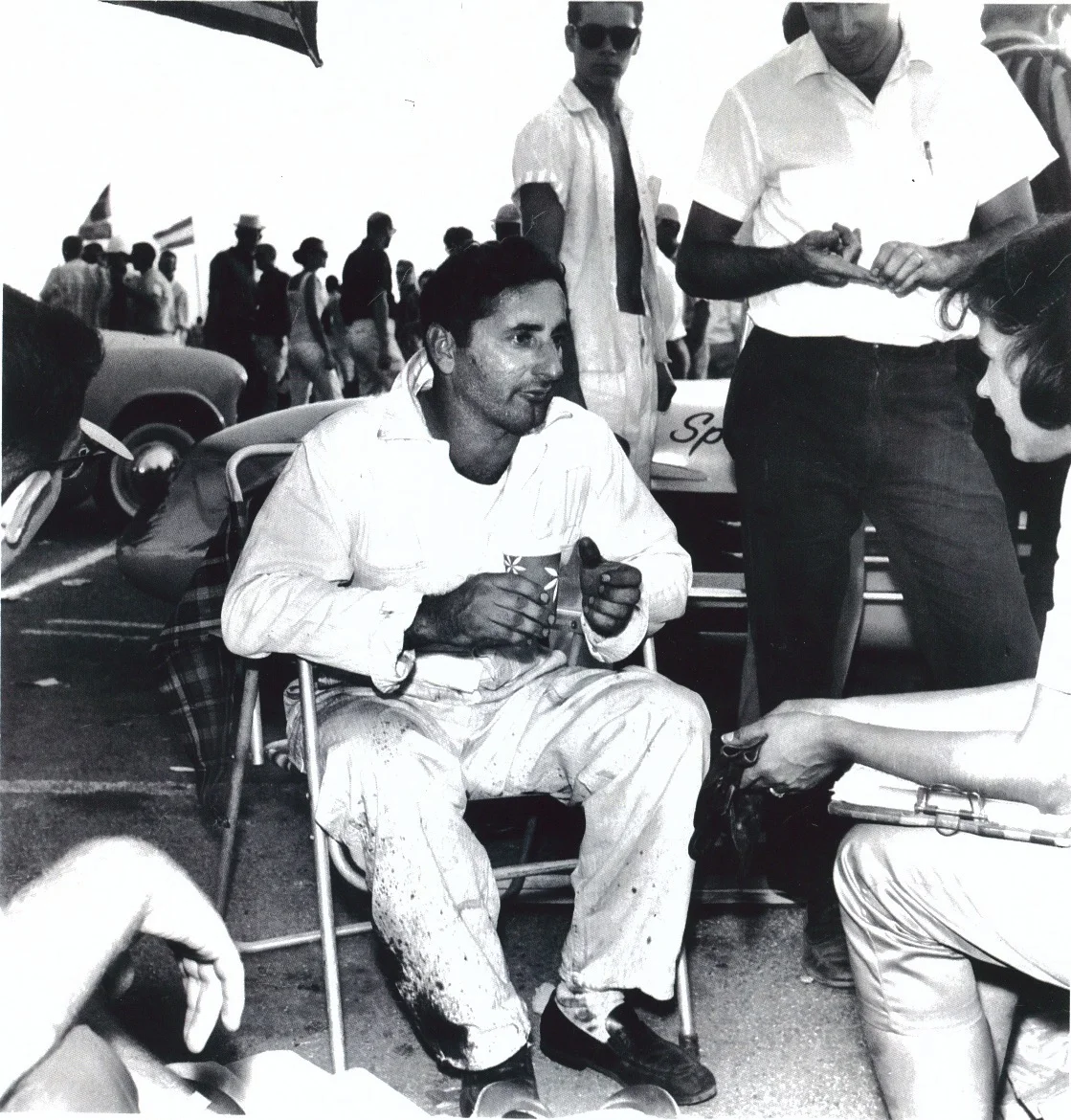
The garage was famous, a center of innovative racing design, yet there was never a sign on the big white building on Hollywood Boulevard. There was an open pit, the classic kind from before hydraulic lifts, covered with long wooden boards. Max always wore his trademark white coveralls, always had a shop rag in his hand, and kept the floors spotless. There were always exotic sports cars in the shop, usually belonging to the movie stars of the era. When I met him he was busy with special projects and movie stunt-car work.
There was always one car mid-way through the famous Balchowsky engine transplant, and nothing was too sacred. Max knew the exact part number of any gasket or bearing that could cross over, and many a GM part ended up in a foreign exotic. There were bins of carburetors, rims and tires (Max hated to throw tires away, even rock-hard ones), distributors, and whole sections of rare foreign parts. In the far right corner, on deflated tires, sat the Old Yeller IX, where it stayed for years. I had a Gullwing Mercedes as a daily driver, and Max worked on my cars for years. I never once saw a bill, which made it hard to work out a fair way to pay him back.
Hollywood stunts
His very good friend Cary Loftin, the godfather of movie car stunts, made sure Max was part of many of his assignments. Max became good friends with Buddy Hackett while setting up the VW “Herbie” for The Love Bug. His most legendary stunt work was setting up the cars for Steve McQueen’s Bullitt. Later he set up McQueen’s Baja race pickup, and he knew Steve well. The last weekend before Bullitt wrapped, there was a regional sports car race near San Francisco, so Max and his friends put numbers on the movie cars and entered them. He worked with Elvis Presley on several films. In Viva Las Vegas he used two Old Yeller race cars, and one was crashed heavily.
Ina
Ina always looked businesslike and serious, and with good reason: for years she was the gatekeeper of Hollywood Motors, because everyone wanted a piece of Max and his extraordinary range of automotive knowledge. His legions of fans went back to the late-1940s street-racing scene and the drive-in. He was proud of his highly modified Studebaker street racer (its Champion rear end went into Old Yeller II), and he gravitated to non-mainstream cars, seeking any strong, reliable part, even one made years before, like an Auburn clutch. Ina did the billing, and she would let you know if you weren’t invited back.
Ina helped lay out the chalk lines for the Old Yeller cars on the shop floor and tuned the cars for the races. She took the brunt of the criticism when they drove Jimmy Summers’ channeled ’32, the Bu-Ford Special, to the Pebble Beach road races in the early 1950s. Max and Ina and their extended family battled the “sporty car” scrutineers, who often nearly ruled them ineligible. In one race the Bu-Ford was at the front of the pack for the first few laps, until the giant military tachometer fell off the steering column and jammed under the throttle.
A week before racing somewhere new, Ina would call the track to ask its length and how many left- and right-hand turns it had, to the astonishment of track managers. When asked why, she would say abruptly that she was setting up the front suspension. She was famous for her perfect lap charts. Once at Riverside, when 3rd and 4th place were disputed, officials called on Ina to settle it with her charts.
She came out with Max to Willow Springs to watch me race a formula car. She brought lunch, and she had her old stopwatch to check the times.
As the years went by after the high-energy racing days, Ina tried selling real estate and led a quiet life. I would go over for dinner from time to time, and she always shopped for special things. When she was stricken with cancer of the upper vertebrae, it was devastating for Max. She had complained of pain for several years, but it went undiagnosed until it was too late for surgery. It was a touching moment when, in the middle of her treatment, she came to Willow Springs. She hadn’t been to a race track since they stopped racing in 1963. When Ina was fighting cancer at Arcadia Hospital, Max and I went almost every night. One night he slipped a $50 bill into my hand and asked me to give it to one special nurse who was caring for her.
Closing the shop
Losing Ina was hard, and so was the closing of Hollywood Motors to make way for a new building. Max hunkered down and wouldn’t face it, and at the last minute he had to call all his friends to help move years of incredible collecting: rare and not-so-rare parts. Max had a key to my garage, and one day I found it full of auto parts, a Maserati engine, and an old cardboard box holding his road racing and drag racing trophies, which had once sat on the shelf of his tiny one-desk office. He spoke of his flow bench with reverence, and for many years it had a special place in my own garage.
Sometimes we had dinner at Algemac’s Coffee Shop in Glendale, where he’d washed dishes long ago while taking night classes in watch repair. It was a hangout for hot rodders in the early days. We spent many late evenings over coffee as he spun out story after story from his racing days.
Bizzarrinis, a Cobra, and Baja
I noticed rare Bizzarrinis, Italian-built with Corvette engines, in his garage. Max was to be a Bizzarrini dealer and loved that combination, which is why he admired the Iso Grifo too. Cary Loftin owned two, and I bought one of them, a GT America, the most perfect of Bizzarrinis and the one car I wish hadn’t gotten away. There was a 1964 Cobra I’d see in the shop from time to time, and Max helped me buy it, a one-owner car. It had Max’s fingerprints all over it: a 351 Windsor, an automatic transmission, and air conditioning with vents coming out of the glove box. When I started racing it, Max insisted I could race with the automatic and wanted to modify it, like Jim Hall perhaps. What an exciting moment that was, racing a Balchowsky-modified Cobra through the esses into Turn 6, fussing with a stock Ford automatic! It was a hot day at Riverside, and I could have turned on the air conditioning.
Once we were to co-drive the Cobra in Baja, with Max driving to the halfway point for me to take the second leg. By then his engine rebuilds used pistons and rods from the used-parts bin; he never adapted to modern high-tech parts and the high cost of racing. He forgot to hook up the fan, and during staging at Ensenada the temperature went off the gauge and the radiator blew. Speaking Spanish, I asked a policeman where the radiator shop was and got a flatbed tow driver, who had just dropped off a race car, to load the Cobra. At the shop, two young boys jumped onto the trailer, pulled out the exploded radiator, repaired it, tested it and reinstalled it, all for $5. I raced to the staging area on a hilly road with no working emergency brake. At the start I took off over the off-camber mountain roads, passed a replica police car upside down, and was into the flats when the motor broke big time. Waiting for the slower cars to pass and the road to clear took a while, so I took a nap on the grass. Max came up to me and said: “What the hell happened to the Cobra?”
He had great respect for Ed Winfield, Cook Machine, Axtell, Pete Brock, Ken Miles and Dan Gurney. Ken Miles took time to explain his approach to racing and to building specials. Once at Pomona he had Max follow him, and Max felt he learned a lot. Max was at Riverside the day Ken died in the GT40 J-car prototype, and he was devastated. When I raced Formula Fords, I think Max would change the cam late at night, against the rules. I was racing a Crossle 55 that no one would buy under any circumstances, the most erratic and evil car I have ever raced.
The archive, and the car
Over the years Max gave me his historical photographs and race programmes, his WWII flight suit from the Burma campaign, his Bu-Ford Special jacket, driving suits, helmets, dash plaques and other memorabilia. I tape-recorded the history with Max, Casper Balchowsky, Jerry Jann, John “Bat” Masterson and others from that period. Max gave me photos of his cars that were now in private hands, though most weren’t being raced. I was searching for an Old Yeller car, but prices were high. I saw the drawings and notes for an innovative possible rear-engined Old Yeller X, paid for the designated parts and chassis, and made a video of the project.
Then Old Yeller II, the most famous of all, came up for sale. Its owner, Dave Gibb of Oklahoma, waited patiently for two and a half years so that I could buy it, knowing I had the race history, the build photographs, and the race photos and trophies. Max was disappointed in the chassis, though he never said so directly. There were square bars poorly welded everywhere, and the odd square roll bar was barely tack-welded on one side. The army-surplus Dzus fasteners didn’t work because everything was tack-welded to the stringers. The nose sat too low, with the carburetors sticking up high above the hood. We have taken the car through a slow rebuild back to 1959 as Max intended. The last element was swapping the Corvette independent rear with half-shafts for the correct solid axle on leaf springs, along with working Dzus fasteners. Max and Ina would be proud indeed.