Other cars
Along with the 1959 Old Yeller II Buick Special, the team races four more historic cars, each with a story of its own.
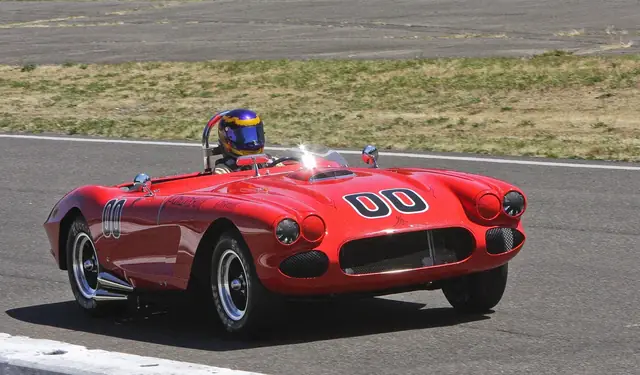
#00 1961 MacDonald Corvette Special
Commissioned by Dave MacDonald and sponsor Jim Simpson, built by Max and Ina at Hollywood Motors, and recreated after a two-year build from the Balchowsky Archives.
“Dave was the ‘chosen one’ in American motorsport, winning championships with ease at all levels. He was on a mercurial rise as fans everywhere watched his journey. Dave was the ultimate American hero: a crew-cut, movie-star-handsome hot rodder and family man, racing American sports cars.”
Dave MacDonald had incredible achievements racing Corvettes but wanted a lighter Corvette race car. Carroll Shelby advised him to have Max and Ina Balchowsky build it. With good Chevrolet sponsorship from Don Steves, Dave and Jim Simpson went to Hollywood Motors. Max built Old Yeller V on the unique Old Yeller design with a lightweight chrome-moly chassis, a 1961 Corvette ultra-thin body and a 327 fuelie motor. Unlike the other Old Yellers, with their Buick drums and Nailheads, it used Pontiac front drums. The finished car raced as the successful #00 “Corvette Special” in the main-event Open Modified class.
Read the full story
The Balchowsky Archives
I was a good friend of Max Balchowsky, and he entrusted me with the entire Balchowsky Archives: the Old Yeller race records and lap charts, invoices, trophies, dash plaques and Old Yeller parts. They included an incredible collection of large-format black-and-white photographs by Lester Nehamkin, a Hollywood photographer and team member. I was given the archives before I bought Old Yeller II.
Fortuitously, I had rare large photographs of Max working with Dave at Hollywood Motors on the Corvette Special, plus images of the #00’s special torsion-bar suspension. For many years I also stored the Max-built chassis for the never-completed Old Yeller X. My payment for that project included the whole custom Balchowsky suspension: drilled front upper Jaguar A-arms (to crush on impact), special drilled backing plates and shortened lower Pontiac A-arms. The archive held a collection of Old Yeller torsion bars and parts, including the #00’s Pontiac front drums with a drilled, slightly damaged backing plate. Only one Old Yeller ever used Pontiac front drums: the #00, because Dave wanted slightly larger front brakes.
Recreation
A fabrication shop built the car, guided by large-format photographs from the archives. Special effort went into using exact period parts, with manufacture dates as close as possible to the #00’s build date. An early-Corvette performance expert built the 1961 327 fuel-injected motor, which makes 350 horsepower, a 5:1 power-to-weight ratio. Cook’s Machine Works assembled a special modified Chevy II rear end exactly as originally built. The two Cook machinists remember working with Max as young men, building the custom rear ends for all his Old Yellers. The car uses the metal seat from the archives, autographed by Max.
An old-school Corvette body fabricator made the razor-thin 1/16-inch fiberglass body to the #00’s exact specifications: 17 inches shorter, 4 inches lower and 5 inches narrower than a stock Corvette. The car weighs just 1,750 lb, and it’s a rocket. The motor sits set back in the chassis, a hot rod trick Max used on all the Old Yellers.
The record
Max completed the #00 in October 1961. Dave was a master of slip angle, or drifting, and fans loved watching him slide through the turns. At first the car wasn’t to his liking; he called it “unnerving.” The original setup worked against his drifting style, so Jim Simpson, manager at Paramount Chevrolet, and Dave took it to Indy chassis builder Frank Kurtis in Glendale to rework the suspension. That evidently suited him: Dave won the first two modified races of 1962 in the Corvette Special. With solid Don Steves Chevrolet backing for a 1962 production Corvette as well, he went for the B Production championship, often running the Special in modified and then jumping into the production ’Vette for his class race.
In June 1962 the car was sold to Honolulu auto dealer Pat Mathis and ran some drag races in Hawaii. That September it came back to the mainland for Reno and the big-purse Northwest Grand Prix at Kent, Washington, where Dave led at one point before mechanical problems. Afterward it was shipped back to Honolulu, thought to have run more drag races, and its whereabouts became unknown.
| Oct 15, 1961 | Riverside 200 | DNA |
| Oct 22, 1961 | USAC Laguna Seca | DNF |
| Nov 12, 1961 | SCCA Regional, Cotati | 1st |
| Dec 3, 1961 | SCCA Divisional, Tucson | DNF |
| Dec 10, 1961 | Del Mar | Raced |
| Mar 4, 1962 | SCCA Divisional, Riverside | 1st |
| Apr 29, 1962 | SCCA Divisional, Del Mar | DNS |
| May 27, 1962 | SCCA Regional, Santa Barbara | Raced |
| Sep 23, 1962 | SCCA Divisional, Reno (#149) | DNF |
| Sep 30, 1962 | USAC Kent (#49) | DNF |
| 1962 (date in question) | Del Mar | DNF |
The launch
The recreated #00 made its official debut at the Pacific Northwest Historics in Kent, Washington, June 30 to July 2, 2023. Key people from the car’s story came: Dave’s son Rich MacDonald and his sister Vicki; Joe Freitas, the iconic early Corvette racer who was there during the original build; and Wally Peat, Dave’s chief mechanic, who built the #00 with Max.
It was a non-stop emotional weekend. Rich, who was battling cancer, told me, “Ernie, I don’t know how many days I have left, but this is the best day of my life, and Dad is watching.” The early Corvette racers gathered for a parade lap. The #00 led the way with Rich and Wally Peat as passengers, and Joe Freitas brought his Corvette racer with Vicki beside him. There were many tears and hugs, and the cars brought everyone together.
1958 Kilpatrick Porsche Speedster
One driver, one car, 33 straight years and 55,000 miles of SCCA racing. It’s thought to be a record in SCCA history.
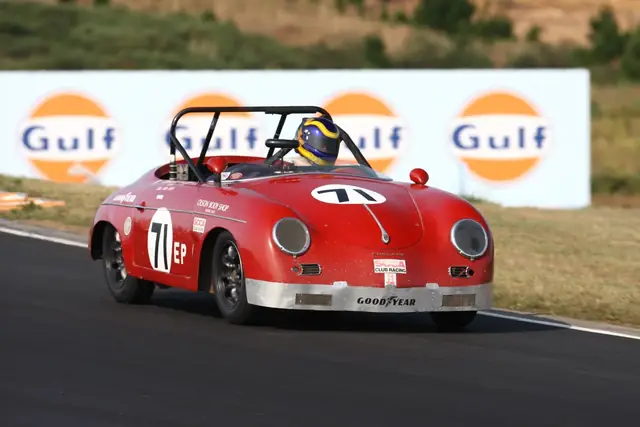
The little red #7 Speedster began its journey with Brigadier General James Kilpatrick at Del Mar in 1964, rarely missed a race as a true American privateer, and logged out in his SCCA logbook at Sears Point on August 10–11, 1996. That’s 33 straight years of tough, fender-to-fender racing.
The General built the engines and did all the mechanical work himself. With the Speedster on a small trailer behind their motorhome, James and his wife Emmy were known at race circuits across the country. The car took on a changing E Production grid over the years, including two SCCA National Runoffs at Road Atlanta. As a pilot, the General kept accurate records: over 55,000 SCCA racing miles. He was always a fair competitor, relying on durability and consistency.
The San Francisco Region SCCA retired the #7 in his memory. The little red Speedster always thought it could, and it did.
Historic racing since
- Rolex Australian F1 GP, 2016Historic race trophy, “Best Historic Car and Team,” Albert Park
- Bruce McLaren Perpetual TrophyCo-winner of the first award, NZ Festival of Motor Racing
- Denny Hulme Trophy, 2016NZ Festival of Motor Racing tribute to Porsche, Hampton Downs, featured alongside Porsche Museum cars
- Rennsport IV & VInvited entrant
- And moreMonterey Historics Porsche tribute, Festival of Porsche at Lake Taupo, Pukekohe, Phillip Island, Donington, and the Archie Scott Brown Trophy at Snetterton
“What a joy… good wheels under me like race cars should be… racing against blindingly fast 1990s Porsche Cup cars with our 1958 Speedster.” NZ Festival of Motor Racing, January 2016.
1964 Shelby Cobra CSX 2203
A 289 Cobra that raced Herbie in The Love Bug and has run in historic racing continuously since 1984.
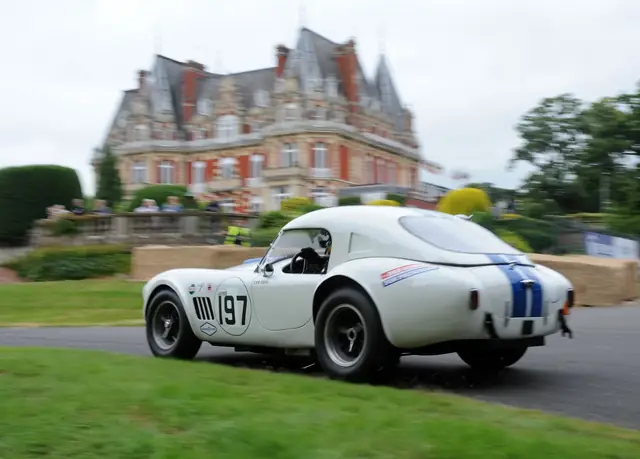
CSX 2203 appeared in the 1968 film The Love Bug, racing against the VW “Herbie” at Riverside Raceway. Ernie is its second owner, and it has raced in historic events continuously since 1984, starting at Riverside International Raceway.
For more than 20 years it raced with one of the three rare original aluminum Le Mans hardtops fabricated by AC in England. Today it runs an exact aluminum replica. It has raced the Tourist Trophy at the Goodwood Revival twice, at the Monterey Historics and Reunion including the Carroll Shelby and Shelby Cobra tributes, and at Palm Springs, Coronado, New Zealand and Australia. In 2014 it was co-winner, with Old Yeller II, of the Rolex Australian F1 Grand Prix historic “Winner” trophy. In 2016 it was a feature car at the Chateau Impney Hill Climb in England.
CSX 2203 at the 23rd Historic Sandown, Melbourne, November 8, 2014, racing with formula cars.
1971 Datsun 510 two-door
Found on a morning walk, bought sight unseen, and prepared in Australia alongside Old Yeller II.
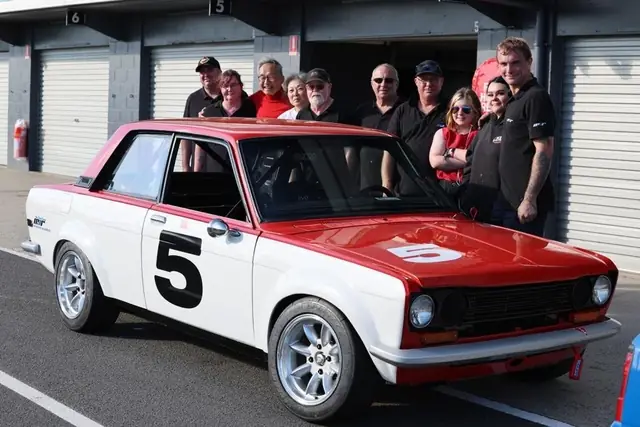
In spring 2022, on my daily power walk, I met a neighbor unloading motor parts for his “track car.” I mentioned that I was a longtime friend of Pete Brock, who worked for Max and Ina at Hollywood Motors when Old Yeller II was built, and that I’d always wanted a Datsun 510, since Pete opened the door for Datsun in the U.S. by winning the championship against the Porsches and Alfas. The neighbor, Feras, said his friend Mike had a 510 he was thinking of selling. When Mike told me it was a 1971 two-door, I almost dropped the phone. That was the ideal 510, the year Pete Brock and BRE won. I bought it without seeing it. Two-door ’71s are hard to find in the U.S., given BRE’s huge following.
Read the full story
We work closely with Mark Johnson of Lilydale, Victoria, whose race shop is one of the most respected in Australia. We were already shipping Old Yeller II to Mark, so we put the 510 in the same container for full race preparation. Over ten months Mark tackled the common rust issues and fitted a professionally welded roll cage, and the detail work was incredible. The 510 fell just short of being ready for the Phillip Island Classic (March 9–12, 2023), because Old Yeller II needed a lot of work after the Sydney Motorsport Park races in December 2022.
What a dream to see and hear the legendary Nissan Skyline GTS-R R31 and HR31 race cars, with Steve Richards and Greg Murphy as the masterful wheelmen, racing fender to fender and nose to tail. We exhibited the 510 alongside Old Yeller II, and the fans’ interest was unexpected. We were told that only four-door Datsun 1600s were imported into Australia. I had met Greg Murphy at the Leadfoot Hillclimb in New Zealand a few years earlier, and it was a thrill to meet him again. Greg signed our race dashboard, leaving room for Pete Brock and John Morton, who had been following the build, and we joined the Skyline photo shoot.
John Morton, the Shelby American driver who sometimes joins us for testing (including our Cobra CSX 2203), raced the 510 for Pete Brock and BRE. In his own words:
“The BRE team had won the SCCA C Production National Championship in 1970 with Datsun’s new 240Z. Peter Brock and the BRE team were asked by Datsun to campaign the 1600cc Datsun 510 sedan for the 1971 Trans Am small-sedan series. I felt that turning this inexpensive economy car into a competitive race car was a big ask… To everyone’s surprise and my shock, we were fastest qualifier at our first race in New Hampshire. We broke in that first race but subsequently won 6 races during the season as well as the Championship. In 1972 the BRE team repeated with 8 victories and another championship. Many say that the BRE team put Datsun on the racing map in the US. I’m proud to have been a part of it.”John Morton
On Sunday, the last day, the low golden Australian sun glowed on Old Yeller II and the 510. It was Old Yeller II’s best run in more than 33 years of international racing, and Mark Johnson’s crew were beaming with pride at the respect fans showed their work on the 510. The weekend couldn’t have gotten any better.